


Here’s a breakdown of the key lessons that can help M&A professionals make better deals and drive long-term value.
Check out the photo's of the Young M&A Forum here (Photography: Vincent Gorissen)
Mergers and acquisitions (M&A) remain a powerful tool for business growth, but what really drives value creation? At a special Young M&A event, sponsored by Ansarada, the next generation of dealmakers had the opportunity to learn from Professor Mathieu Luypaert (Vlerick Business School) – a leading expert in M&A strategy.
The Young M&A Community was welcomed by Charlotte Declercq, who introduced Professor Luypaert and announced the next Young M&A event – a padel tournament set for May 22, 2025.

An expert in M&A value creation
For years, Professor Mathieu Luypaert has been researching value creation in M&A. What factors contribute most to successful deals? And which ones lead to value destruction?
Luypaert, an Associate Professor of Corporate Finance at Vlerick Business School, made the decision in 2004 to specialize in mergers and acquisitions. Now, twenty years later, he remains deeply engaged in the field – not only as a professor but also as a researcher and director of the Centre for Mergers, Acquisitions and Buyouts at Vlerick. Over the years, he has gathered extensive data and insights, further fueling his passion for the subject.
10 facts about M&A and value creation
In his keynote, titled ‘Value Creation for the Next Generation’, Luypaert structured his talk around 10 key facts about M&A and value creation.
“Remember”, he emphasized, “these are facts, not opinions.”
1. M&A creates value
The first fact? M&A does create value.
“You often hear the opposite”, Luypaert pointed out. “According to Harvard Business Review, 70 to 90 percent of deals are said to fail in creating value.”
However, he argued that many of these conclusions are based on outdated research. New evidence suggests that M&A does, in fact, create value.
“When looking at stock market effects, targets typically gain around 30 percent in value when they are acquired, while acquirers see an average increase of 1 percent”, he explained. “And on average, newly formed business combinations grow faster than their industry benchmark.”

2. Not at the Expense of Human Capital
A common misconception about M&A is that acquisitions lead to significant job losses.
“Not true”, said Luypaert. “In fact, the opposite is true: acquisitions lead to a 10 percent increase in jobs. This also applies to cross-border deals. When shareholders gain value from a deal – which they do on average – employees benefit as well.”
In today’s job market, where talent shortages are a growing concern, attracting skilled employees has become an increasingly important driver of M&A activity.
According to research, the top three deal drivers remain:
• Achieving economies of scale (still the primary motivation)
• Cross-selling opportunities
• Access to new technology
However, attracting talent – also known as an ‘acqui-hire’ – has climbed from eighth place in 2015 to fourth place today, reflecting the shifting priorities of modern dealmakers.
3. If not overpaid
The value creation discussed earlier only holds true if acquirers don’t overpay for their targets.
“In a valuation, you start with the standalone value of a company and then estimate the synergies you can achieve. The space between these two figures defines your negotiation range. It’s crucial to make this distinction very clear”, explained Luypaert.
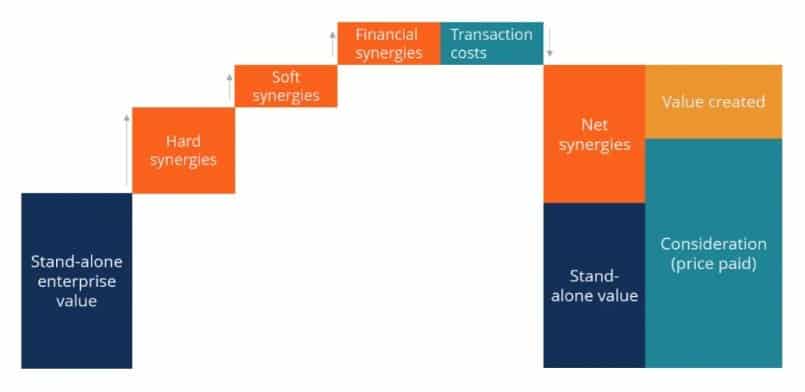
Source: Corporate Finance International
One of the biggest reasons companies overpay? Hubris.
“Buyers often overestimate the synergies they believe they can realize”, Luypaert said. “They may also become emotionally attached to a target – essentially ‘falling in love’ with it. If they find themselves in a competitive bidding process, with multiple offers on the table, the risk of overpaying increases significantly.”
To get a better sense of industry-specific deal valuations, Luypaert recommends consulting the M&A Monitor from Vlerick Business School, which tracks multiples paid across various sectors in Belgium.

4. Timing is key
M&A activity tends to occur in waves, often driven by major economic and technological shifts.
“For example, around 2000, there was a surge in deals due to the technological revolution, deregulation, and internationalization”, explained Luypaert. “This was followed by a downturn after the dotcom bubble burst. Similar patterns occurred between 2003 and 2007 and again from 2013 to 2022, with a brief pause during the COVID-19 pandemic in 2020.”
Interestingly, research shows that the most value-creating deals are made outside of these waves.
“There are a few reasons for this”, said Luypaert. “First, deal prices tend to be higher during M&A waves. Second, CEOs often influence each other, leading to acquisitions driven more by momentum than strategy. Outside of these peak periods, valuations are typically lower, which results in better deals.”
5. Smart deal structuring adds value
Attention, lawyers in the room! Deal structuring plays a critical role in maximizing value – especially in times of inflation and rising interest rates.
“Despite economic uncertainty, acquisition prices have remained relatively stable”, said Luypaert. “However, we’ve seen a significant shift in deal structures, with debt financing hitting a low point in 2022. Either banks have become more cautious in granting acquisition loans, or buyers are using them less due to rising costs.”
With traditional financing becoming more challenging, dealmakers have increasingly turned to deferred payments as a way to manage financial constraints.
“Today, 39 percent of transactions involve a ‘vendor loan,’ allowing buyers to defer part of the acquisition price. Additionally, 36 percent of deals include an ‘earn-out’ – a variable deferred payment tied to post-acquisition performance”, Luypaert explained.
While earn-outs can be financially advantageous, they also come with risks.
“They make sense from a financial standpoint”, he notes. “However, they can lead to difficult negotiations later on. That said, investors tend to favor them.”
His key advice? Keep earn-outs focused on the first two years after the deal – three years at most.

6. CEO, CFO and the board determine M&A success
Are bad acquisitions the result of bad companies or bad boards? Research suggests that the board of directors plays a crucial role. “CEOs with deep industry knowledge can significantly improve the chances of a successful acquisition”, said Luypaert. “Independent directors also have a strong positive impact.”
But what about CFOs? “Yes, they matter”, Luypaert explained. “But only when they have real influence within their companies and the CEO actually listens to them. Strong CFOs recognize good deals and are less likely to overpay.”
Luypaert also had one key piece of advice for young dealmakers: Avoid acquiring companies led by a narcissistic CEO. “How can you tell if a CEO is narcissistic? Listen to their speeches and pay attention to pronoun usage. Do they say ‘I, Me, Mine’ – or do they focus on ‘We, Us, Them’?”
7. Supported by an internal M&A team
Companies with an internal M&A team tend to execute better deals. But what does an effective M&A team look like?
“There’s no one-size-fits-all model”, said Luypaert. “Every company structures it differently. The team might include finance professionals, business development experts, general counsels, and Vice Presidents of M&A.”
Research from the Journal of Financial Economics confirms that internal M&A teams contribute to value creation – particularly in the deal origination and post-merger integration phases.
“During the middle of the deal process – especially negotiations – the team tends to be less involved,” Luypaert explained.
8. But the right advisor can help
Do investment banks impact M&A returns? Yes, they do, according to research Luypaert cites. But how do businesses choose the right advisor for a deal?
Luypaert offers three key tips:
• Focus on the individual, not just the firm.
“It’s the banker that matters, not just the company. Have different advisors pitch and look for a strong personal connection.”
• Consider boutique advisors for complex deals.
“In intricate transactions, boutique advisors often outperform larger firms.”
• Prioritize industry and regional expertise.
“Specialized knowledge in a sector or country can make a significant difference.”

9. It pays to follow private equity
Research suggests that deals initially considered by private equity (PE) but later sold to strategic buyers tend to generate higher-than-average returns.
“A study examined transactions where a private equity firm first evaluated a target before it was ultimately acquired by a strategic buyer”, Luypaert explained. “These deals performed better than the average acquisition.”
Why? Private equity firms excel at picking high-potential targets.
“Tracking transactions involving private equity – such as exits, buyouts, and add-ons – can be a valuable strategy”, Luypaert suggested.
Historically, private equity was often seen as the ‘Barbarians at the Gate’, a reference to the famous book. But that perception has evolved. “While cost-cutting and efficiency remain part of the equation, today’s private equity firms are primarily focused on growth”, Luypaert noted.
10. The rising importance of data analytics and AI
AI is revolutionizing M&A, helping buyers identify the right targets and conduct faster, deeper due diligence. The next generation of dealmakers must embrace these technological advancements to maximize value creation.
“Asset managers can now predict which companies will be acquired, while young M&A lawyers can let AI draft parts of their contracts while they sleep”, Luypaert noted.
Currently, technology is primarily used for:
• Target screening
• Due diligence
• Valuation
However, it is less frequently applied to:
• Acquisition strategy development
• Contract drafting
• Post-merger integration (PMI)
Luypaert shared a compelling example in which AI is used in PMI: “Imagine two banks merge. With AI, they could build a model to predict customer churn after the acquisition – identifying which customers are likely to leave. This would allow them to focus retention efforts strategically.”
Despite its potential, AI in M&A still faces hurdles:
• Limited access to data
• Ensuring data quality
• Lack of expertise
A great talk, great networking
After Luypaert’s insightful presentation, the Young M&A Community continued the evening with networking, delicious snacks, and drinks. Because while they love great content – especially from engaging speakers like Professor Luypaert – they also love to connect.

