

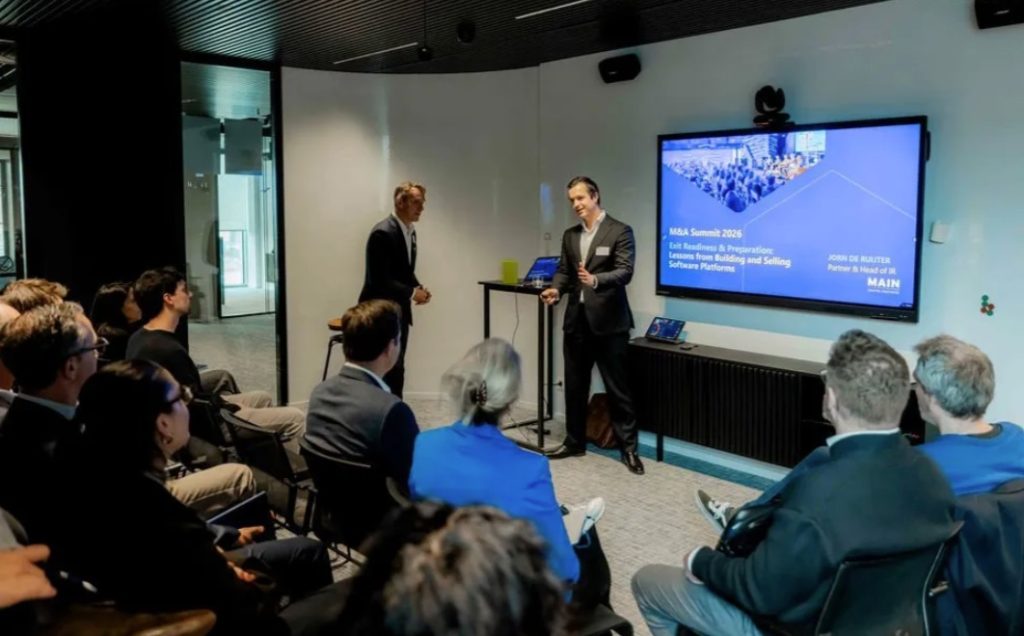
What does the strategic blueprint behind one of Europe’s most active software investors look like? How are they structured? And what returns does that generate? At the latest M&A Summit, Jorn De Ruiter, Partner & Head of IR at Main Capital Partners, was keen to answer those questions.
Over the past 20 years, Main Capital Partners has transformed from a small team in The Hague into an investment fund with 6 offices, around 100 employees and 7 billion euros in assets under management.
They have 89 companies in their portfolio, which together generate 1.3 billion euros in turnover. Their focus has remained unchanged throughout this time: exclusively B2B enterprise software in Europe and the United States. Think of names such as Oribi, Epona, cisbox or Björn Lundén.
One thing you have to give Main Capital credit for: they maintain a rigorous focus on ‘exit readiness’. According to De Ruiter, the exit is, after all, the ultimate test for any private equity player: ‘Delivering on the exit is really where you demonstrate your strength and your true performance.’
De Ruiter emphasized the integrated, cross-border approach. Instead of regional silos, Main works with specialized product markets such as Healthcare, GovTech, e-HR and Cybersecurity.
“We have an integrated approach where we hold a cross-border call every 2 or 3 weeks with all members active in a particular product market”, he explained. “This enables them to identify trends and proactively build relationships with strategic buyers. And that’s long before an official sale process begins.”
Buy-and-build as a flywheel
The core of value creation at Main lies in the buy-and-build strategy they employ, explained De Ruiter. Through acquisitions, individual software companies are transformed into larger, internationally operating and more profitable groups. This is not just a matter of scale, but also of integration. A fully integrated group is simply worth more at the time of sale than a loose collection of companies where the buyer still has to do the integration work themselves.
The figures speak for themselves: with 38 exits realized to date, Main achieved a weighted gross money multiple of 4.7x and a gross IRR of 43 percent. Almost all exits (95%) yielded at least double the initial investment.
What also sets Main Capital apart is its internal Performance Excellence team. This team conducts thorough research into market conditions and keeps a close eye on all ongoing M&A operations. Based on this, standardized playbooks, best practices and scenarios are developed. A crucial part of this is the Exit Readiness team. Among other things, they focus on optimizing data quality by, for example, creating a detailed ‘customer data cube’ in which all add-on acquisitions from the past three years are integrated on a comparable basis. In addition, they streamline reporting by creating financial templates and dashboards with relevant KPIs. This ensures they are immediately available to potential buyers.
12 months in advance
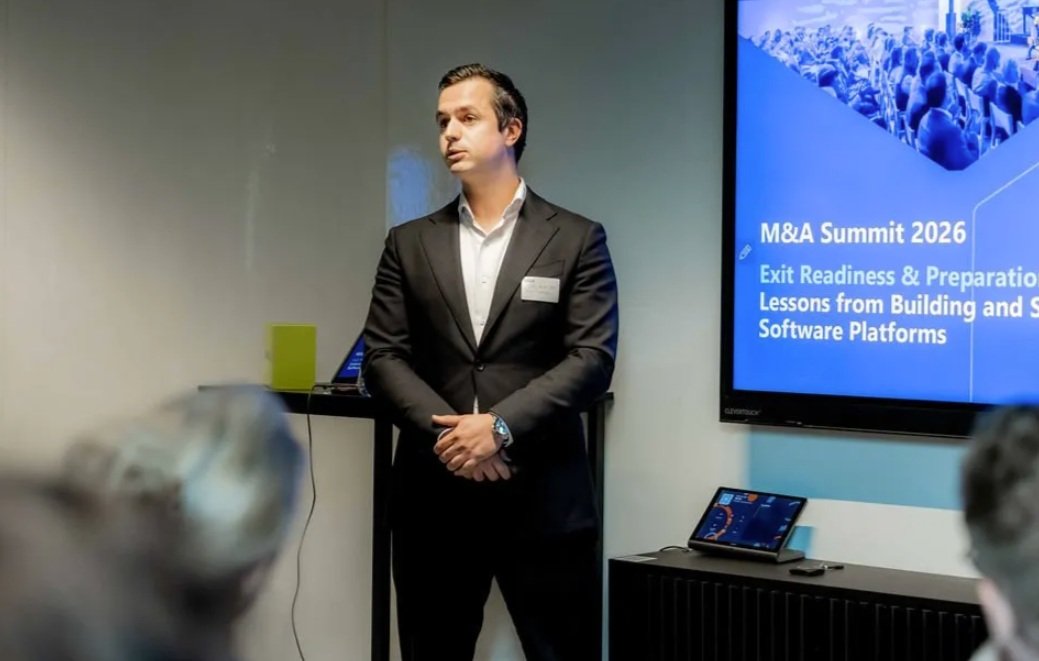
According to De Ruiter, preparations for a sale often begin as early as 12 months in advance. Main is also increasingly opting to manage the sales process entirely in-house, without the involvement of external investment banks. “In recent years, we have decided that we want to have these exit capabilities internally at Main as well, and therefore do not want to rely exclusively on processes led by advisers”, said De Ruiter.
A striking example of this approach is Textkernel, an Amsterdam-based HR software company that was acquired via a carve-out in 2020. During the investment period, turnover almost tripled through organic growth and three strategic acquisitions, including the US-based Sovren. The eventual sale to the US-based Bullhorn in 2024 was entirely managed in-house by Main. In just six weeks, Main orchestrated a successful exit with a money multiple of more than 5 times the initial investment.
Strategic buyers
Although Main sells to various parties, in 70 percent of cases a company ends up with a strategic buyer. These are often companies that are themselves backed by other private equity players. De Ruiter calls this the ‘Holy Grail’: you get the strategic premium on the sale price, but you work with a buyer who speaks the same professional language as Main and who can also act quickly.
Moreover, Main sees many repeat buyers. Parties such as Visma and Bullhorn have already acquired companies from Main on several occasions. “This testifies to a strong reputation in the market; buyers know they can trust that Main’s assets are well prepared in terms of quality”, said De Ruiter.
Continuation funds
Meanwhile, Main is also experimenting with relatively new instruments such as ‘continuation funds’. This enables them to retain successful companies for longer, whilst allowing investors (Limited Partners) who wish to do so to still realize their capital.
De Ruiter illustrated this with the example of the SDB Group, a well-known Dutch software company in the healthcare sector. As this company had been held in various Main funds over the years , the terms of those funds were no longer synchronised. By setting up a continuation fund, the older funds were able to exit with a solid return, whilst Main can continue its buy-and-build strategy for the coming years with new and existing investors.
The Impact of AI
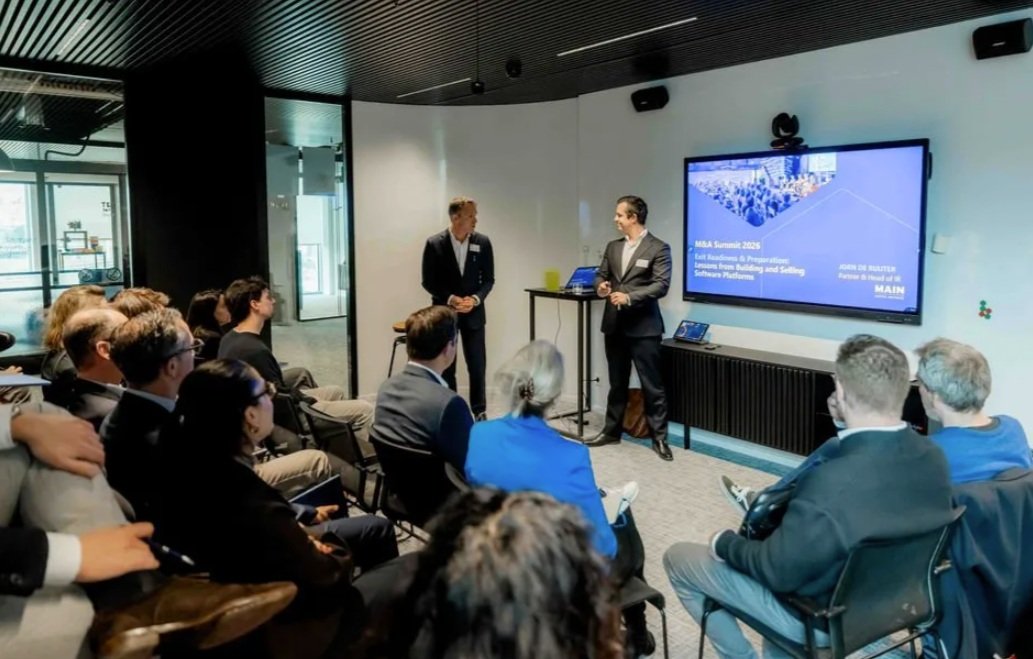
No discussion about software can ignore AI these days. De Ruiter acknowledged that AI looms large over the software market and is prompting buyers to take a more critical view. They are carefully assessing whether the software is an essential system of record or a simple tool that can easily be replaced by AI.
Main has also refined its investment strategy in this regard and is now scrutinizing the AI maturity of its portfolio companies even more closely. Product markets such as GovTech, HR and Cybersecurity are seen by them as less vulnerable to AI disruption than more ‘nice-to-have’ solutions. “Thanks to these market shifts, buyer interest in high-quality software companies remains strong, although historical valuations of twenty times EBITDA are currently less realistic”, said De Ruiter.
No side issue
In the current volatile market, ‘exit readiness’ is not a side issue, but a core competence, concluded De Ruiter. Main Capital combines its buy-and-build strategy with strong operational support and a proactive approach to the buyer’s market. Success in private equity is therefore as much a matter of a shrewd acquisition as it is of equally shrewd preparation for sale.