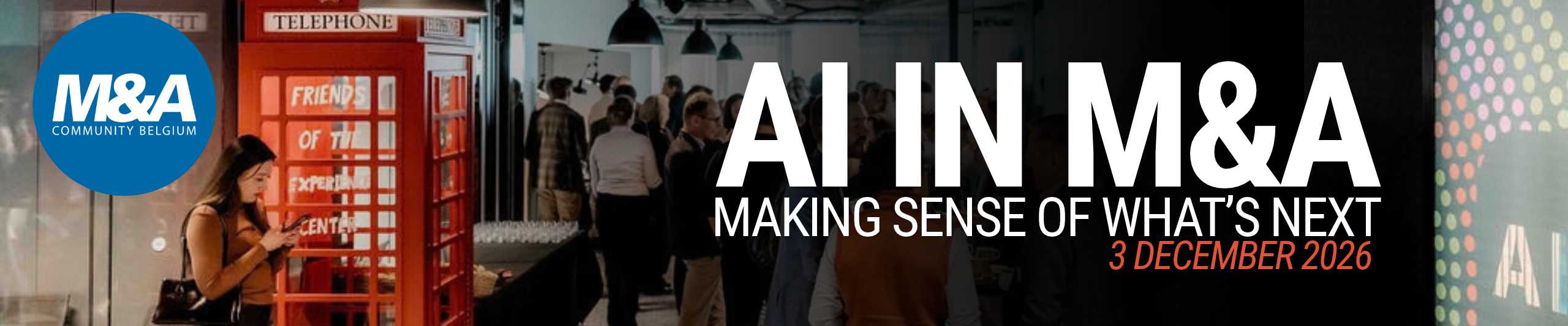


Belgium’s M&A community spent 2026 moving AI from a side tool to a question about how deals get done. On 3 December, it decides what comes next.
Before the M&A Trend Forum opened at BDO on 26 February 2026, a small group of Belgian M&A directors gathered around one table to talk about artificial intelligence. At the time, much of the room still saw AI as an efficiency tool – a faster way to screen targets or work through an information memorandum – but there was still some uncertainty about AI’s full potential and how to leverage it.
Read also: From ‘efficiency toy’ to game-changer – Insights from Belgium’s top dealmakers
One question dealmakers grappled with was: Who owns AI inside a firm? Magali Fiechter-Deloof, founder of Nextwire, put the balance at 90 percent people and 10 percent technology, saying “leaders who delegate AI transformation to their IT departments are setting themselves up for failure”.
In March 2026, PwC Belgium Partner and Deals Lead, Veronique Gillis, described AI working on three levels at once: the strategic rationale for a deal, the targets themselves and how deals are executed, explaining that this makes it a boardroom question before it is a tooling one: “Many board-level strategies now include explicit AI components, such as the automation of core processes, new AI-enabled products, or data monetisation. When those capabilities can’t be built fast enough internally, companies turn to acquisitions to source the teams, models, data assets, or platforms they need.”
By spring, the conversation had moved into the deal room itself. In April, Jurimesh Head of M&A and Legal, Maurits Arnauw, told us that “even traditional law firms are looking into launching pilots for due diligence and deal drafting”.
Moreover, he noted that the young professionals coming into the business grew up with technology and LLMs like ChatGPT.
“Prompting is part of their daily routine – some don’t even use Google search anymore. It would be naive for a law firm to disregard this.”
Prompt-first dealmaking
Ansarada’s managing director Justin Smith also pointed to a rise in prompt-first dealmaking. “Whether it is an acquisition, capital raise, IPO or procurement process, success has often come down to how effectively teams can work through large volumes of documentation under time pressure,” he explained.
Although virtual data rooms improved security, organisation and document sharing, the fundamental nature of the task remained unchanged. Deal teams continued to dedicate endless hours to manually searching through folders, examining documents individually, and piecing together information across thousands of files.
Justin noted that this is the core operational problem that separates AI data rooms from traditional virtual data rooms, as AI data rooms can help reduce the time a due diligence process takes from months to weeks.
Throughout conversations in 2026, dealmakers cautioned that speed comes with a catch, making professional judgement more important than ever. They all agreed that people must still frame the questions, check the output and make the final call.
Justin stressed that trust has always been the foundation of successful transactions and will be just as fundamental when working with AI. “A single decision can carry serious commercial, legal and reputational weight, which is why transparency and governance cannot be treated as an afterthought… An answer no one can verify is of no use in a transaction.”
Read also: From simple prompts to systems intelligence
Higher scrutiny
Veronique also warned that dealmakers still need to use their expertise to discern between false promises and what’s possible when it comes to AI: “Vague references to ‘AI potential’ should not attract large premia. You need a disciplined framework rather.”
By the end of the first quarter, this scrutiny started showing up in the M&A markets. “At the top of the K, we saw mega deals of high-quality assets in trending industries – tech, energy transition, healthcare, critical infrastructure, and certain B2B services – that attracted intense competition from strategic and large PE funds,” Veronique unpacked PwC’s Global M&A Industry Trends - Outlook 2026 report. At the bottom of the K were assets with cyclical exposure, structural challenges or complex needs – such as subscale industrials facing decarbonisation costs, traditional retail, and certain real estate segments.
By November, Ansarada's 2027 M&A Predictions Report showed how far that thinking had travelled. Buyers now test whether a target's business model will survive AI, and a weak answer can remove a large share of bidders before a process properly starts.
Kmart and the K-shape
During the Private Equity Summit 2026 on 22 October, Loyens & Loeff AI Solutions Lead and KU Leuven Research Fellow, Wessel Wijtvliet, provided a practical example to put it into perspective. He contrasted Kmart, which used barcode scanners to speed up its existing processes (the bottom end of the K-shape), with Walmart, which redesigned the whole business around the information it got from the barcode scanners (the top end of the K-shape).
“What Kmart did was: we need fewer people behind the cash register, and those people can work faster and make fewer mistakes. To put it in corporate parlance: they could be efficient and effective. Something you probably hear a lot about AI as well,” Wessel shared. Walmart, on the other hand, turned every product into a data point. That changed its relationship with suppliers, who had to adapt to its data-driven system, and with consumers, as Walmart – rather than third parties – understood what sold.
The question for AI, Wessel said, is the same.
“Is AI a tool that makes you as an individual a bit faster? Or is it something that challenges you to completely reinvent the way you do your business?”
AI movers & shakers
Belgium’s M&A industry is already reorganising around that question, with various appointments focused on AI and tech skills. In August 2026, EY-Parthenon hired Leong Cheung, a senior consultant for data and AI in strategy and M&A, and in November, Four & Five appointed Jan van Loon as a senior associate in its tech, data & IP team.
KPMG Belgium’s head of M&A advisory, David Theys, raised an uncomfortable corollary: if AI absorbs much of the junior workload, nobody knows where the next generation of senior dealmakers will come from. He does, however, expect AI to create roles no one has imagined yet, and he is also certain it won’t replace relationships and experience.
Making sense of what’s next
On 3 December 2026, the M&A Community Belgium will gather at Polestar Brussels South to pull this year's AI lessons together and set the agenda for the next. Helen Lu, associate professor of accounting and AI at Vlerick Business School, will open with how to choose AI tools, process complex information and keep costs under control. Dentons' Europe innovation & intelligence director Břetislav Šimral will follow with how the firm turns challenges into solutions through AI, hackathons and rapid prototyping.
After a break, Ansarada’s regional growth director, Willem van Aalst, will show what it means to ask your data room questions without giving up security and control, followed by Jurimesh co-founder and CEO Jorrit Willaert’s presentation on AI agents in legal due diligence. Duely co-founder and CEO Michiel Van Lerbeirghe will close the event with what they learnt while building an M&A legal practice from scratch.
For a community that started the year asking whether AI was more than an efficiency tool, it is a fitting place to end it.
Register now and join the conversation!