

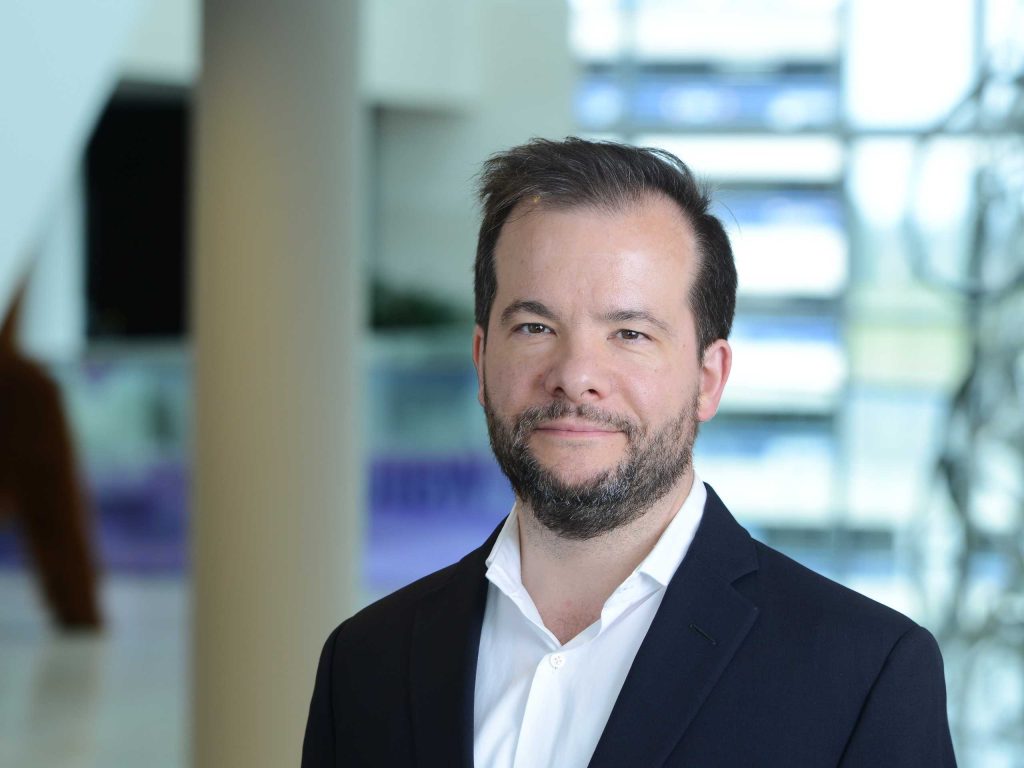
David Theys has spent more than 25 years moving through the world's financial capitals – in London, Paris, Moscow, Dubai, Hong Kong – before settling, a decade ago, back in Belgium. Today he lives in Antwerp and is based close to Brussels, but his career reads like a map of global finance: investment banking, corporate finance, restructuring, debt advisory, valuation.
Over the last 10 years, after having initially joined Clairfield International, David has founded and expanded the Belgian office of Dutch M&A and debt advisory boutique Nielen Schuman and had a two-year stint at US investment bank Houlihan Lokey. Since August 2025, he has held the title of Head of M&A Advisory at KPMG Belgium, a role that puts him at the centre of the firm's ambitions in mergers and acquisitions. He also lectures occasionally at Hasselt University, teaching Bachelor's and Master's students in Business Economics the practicalities of corporate finance – the kind of hands-on knowledge, he says, that no textbook can fully capture.
But it is the KPMG mandate that currently defines his working life: not starting from zero, but taking an already solid practice and driving it to the next level of growth.
Sharpening and scaling KPMG’s M&A Advisory practice
David is candid about what the first months of a new role actually look like. "When you start, you can count on the first six months being a kind of internship," he says. A mandate he landed in January nearly slipped away when the seller entertained a competing bid – only to return in May. "That's one of two M&A sell-side projects I am currently preparing. So far, so good – I'm quite pleased."
The bigger task, though, is structural. David was brought in to sharpen and scale an M&A franchise that already had a solid foundation in place, with a team he describes as genuinely strong on substance. "The quality is there," he says – the work now is in channelling that quality more deliberately toward dealmaking: sharpening the instinct for the bigger picture behind each request, and building a shared sense of what the team wants to be delivering 6, 12 or 24 months from now.
His answer has been to sharpen focus around specific subsectors where he sees genuine opportunity: technology and software, B2B and professional services, transport and logistics, technical installation and, increasingly, healthcare. "Healthcare is one area we haven't been active in yet, but I think with recent developments towards a cancer vaccine there will be a lot more interest," he says, predicting a wave of activity in medical, life sciences and biotech-adjacent sectors over the coming years.
Crucially, he is leaning on colleagues elsewhere in the firm – particularly KPMG's technology due diligence specialists – even though they don't formally sit on his team. "They know the technical substance far better than I do. They can go two layers deeper into the details," he says.
"It's important to build alliances with people like that and work together."
Reputation is being built deal by deal
Distinguishing a Big Four M&A practice from established boutiques and investment banks is no small task, and David is realistic about the obstacles. His response is to initially target a specific niche: privately-held, family- or entrepreneur-owned companies valued below 100 million euros – deals too small for most private equity-focused advisors, but a strong fit for KPMG's broader network.
"A private, founder-owned deal usually is more complex than a company already owned by private equity – PE firms have good systems, experienced people, and things generally move more smoothly. That's a real niche for us, as we can bring our firmwide expertise beyond M&A advisory truly to bear in these kinds of situations, for example by collaborating with our carve-out and restructuring experts or our CFO advisory team, as well as delivering an integrated solution together with our due diligence, strategy, tax and legal specialists," he explains.
Reputation, he says, is being built deal by deal. Recently his team pitched for an M&A sell-side mandate for a company worth more than 100 million euros, competing against three other firms. "Without naming names, we're now being invited into situations where until recently we wouldn't have been. It's the work of a long time."
What differentiates KPMG longer-term, he believes, is the combination of a global network with genuine local relationships – colleagues based in offices in Ghent, Antwerp,Hasselt and other cities in Belgium who are not corporate finance specialists, but know local entrepreneurs personally. "These potential clients sit across the table from the KPMG accountant or lawyer and can ask, 'is there someone who should come in on this M&A situation?' These locally based colleagues are the ones who can pick up the early signals."
Activity is healthy, but it's not the full-throttle market of 2018/2019
Having watched the Belgian market since 2016, David has seen the cast of players shift repeatedly. "When I returned to Belgium after more than 20 years abroad, I saw a market dominated by Rothschild, with the Big Four and the commercial banks gradually retreating. A lot of the individual names from back then have moved on," he says, citing the rise of firms like Kumulus and newer entrants such as Modena Partners.
What stands out to him is how personal the mid-market, which he defines as composed of the M part of the SME segment, remains. "It's less institutional and more about relationships between people," he says. One entrepreneur told him directly: "I didn't hire KPMG, I hired David" – a comment he describes as genuinely rewarding, not for the ego boost, but because "it reflects the trust you build as a person, in the middle of the mid-market especially."
On overall deal activity, he is measured rather than bullish. "I don't think we've seen a real flood of companies moving into private equity hands in the last few years – activity is healthy, but it's not the full-throttle market we saw in 2018–2019." He points to a post-COVID lull that has squeezed out advisors lacking strong networks and infrastructure:
"There are a lot of players without the systems and networks to sustain themselves."
Family offices in Belgium hold a lot of capital
Belgium's private equity landscape, David says, remains smaller and less mature than that of its northern neighbour. "Family offices here hold a lot of capital – something like 40 billion euros – which fits the Belgian character," he notes, contrasting this with the roughly 300 private equity funds active in the Netherlands. "That was actually part of my thesis in 2016, that Belgium was at that time roughly ten years behind the Netherlands in that respect."
He now sees Belgian family offices professionalising rapidly, increasingly behaving like institutional private equity funds – albeit with two structural advantages: a single pool of capital, and the patience for a longer investment horizon.
One emerging theme is the growing interest from government-linked funds – the federal SFPIM, the Flemish government fund, and others – in defence and industrial resilience. David treats the sector carefully. "Defence is already a sensitive area, and it's political too, which adds another layer," he says, though he notes real synergies with aerospace and industrial supply chains his firm already understands well.
AI affects sectors differently
Few conversations about the current market avoid the subject of artificial intelligence, and David sees its impact as broad but uneven. "I think every company needs an AI strategy, and there will be large sectors that are affected differently," he says, citing an unlikely example: a friend who runs a wooden-pallet manufacturing business using AI simply to detect and repair damaged pallets.
Software, healthcare and professional services, he says, face the deepest disruption – though not always in the direction people expect. Many software companies, he notes, are treating AI as an enabler rather than a threat, since deep client integration makes switching costly. "We already have the clients, we just need to build add-ons," is how he characterises their thinking.
For David, the more interesting opportunities often sit one step removed from the obvious AI verticals – in the infrastructure that makes the technology possible in the first place, rather than the applications built on top of it. "There's more to it than the obvious verticals. Certain sectors have players with real branch-specific knowledge," he says. "It's the picks-and-shovels play – not the owners of the railway, but the people who supply it." A data centre is one thing, he explains, but the cables, power systems and technical installation companies connecting to it are where the real bottlenecks – and the real investment opportunities – lie.
He is equally candid about AI's likely effect on his own profession. "KPMG as a firm puts a lot of effort into being ahead of the curve on AI adoption, taking into account the obvious data governance constraints. I believe AI will affect the way firms like KPMG staff projects and how they will get rewarded by clients, putting more emphasis on results and less on effort. This has obviously already been the case in M&A for many years as fee structures always contain a large contingent part, but our colleagues will gradually need to move to a similar model in the coming years. What AI cannot replicate are relationships and experience – I think this is where the value-add delivered by professional services firms increasingly will be." The open question, he admits, is where the next generation of senior dealmakers will come from in case the pessimistic scenario of a narrowing junior pipeline plays out. "I don't have a good answer to that, but I strongly believe that AI will create many new jobs that we haven’t thought about yet, also in our sector."
What David enjoys in his work — and what makes deals succeed
Beneath the market analysis, David is animated most by the human side of dealmaking. "The thing that matters most to me is really getting to know a business," he says.
"A number of founders and CEOs have told me things they said they couldn't even share fully with their own team – that level of trust is something I really value."
Asked what separates successful deals from failed ones, he points to commitment rather than capital. "If someone wants to put in a lot of money but isn't genuinely willing to commit to a 3 to 5 year partnership, that's a risk – both for the person and for the party investing."
He is equally attentive to the emotional undercurrents that rational due diligence can miss: "sometimes it's simply saying, 'let's pump the brakes here', while you can see it in the eyes of the person on the other side."
A closing reflection
What emerges from David's account is less a triumphant growth story than a patient, deliberate rebuilding – of reputation, of trust, of a team learning to think several steps ahead rather than just executing the next analysis. Whether the subject is sector strategy, private equity's slow professionalisation in Belgium, or AI's uncertain reshaping of the advisory profession, his instinct is the same: relationships and track record cannot be shortcut, only earned over time. "It's a long race," he says of his ambitions at KPMG – and he sounds entirely at peace with that.

