


A fast climate transition creates both risks and opportunities, but BNP Paribas Fortis' Chief Economist and Chief Investment Officer believe strategic investment can prevent catastrophe.
How the climate transition plays out will redraw the global economic map. Oxford Economics' Global Climate Service (Q4 2025) compares a fast transition with today's muddling-through baseline. In that baseline, carbon prices rise only modestly and the world warms by 2.2°C by 2060.
The comparison shows that a fast transition is not a uniform shock: some countries gain and others lose. In a climate catastrophe, however, nobody wins.
The winners of a fast transition
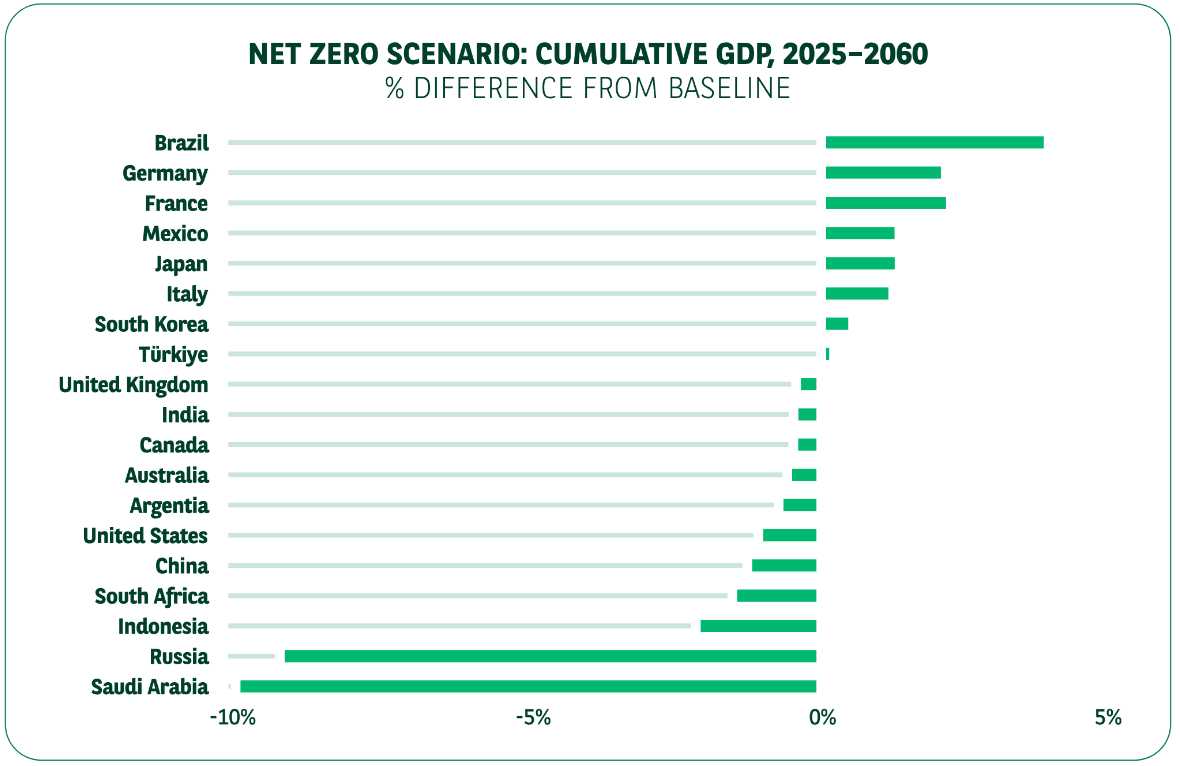
In the Net Zero scenario, early policy action, technological progress and global coordination bring CO₂ emissions to net zero by 2050. Brazil, Germany and France gain the most.
Measured as cumulative GDP over 2025–2060 versus baseline, Brazil gains about 3.7 percent, while Germany and France each gain about 2.1 percent. Mexico (+1.3 percent), Japan (+1.1 percent) and Italy (+1.1 percent) also finish in positive territory.
Two factors set the winners apart. The first is high renewable electricity capacity. Countries that depend more on low-carbon, untaxed energy face a smaller carbon tax bill and less inflation pass-through. The second is access to the metals and minerals that green technologies need, such as copper. Higher prices for those commodities boost export revenues.
Source: #chartchat40, based on Oxford EconOmics Global Climate Service
The losers of a fast transition
Saudi Arabia (−9.8 percent) and Russia (−9.0 percent) take the hardest hit as fossil fuel revenues shrink. Economies with high fossil fuel intensity are also structurally exposed. Indonesia (−2.0 percent), South Africa (−1.3 percent), China (−1.1 percent) – whose main weakness is its coal dependency – and the United States (−0.9 percent) all end below baseline.
Even the winners pay a price at first. Steep carbon prices, fossil fuel demand that barely responds to price in the short run, and higher electricity costs push up inflation and erode real incomes. World GDP falls about 4 percent below baseline in the early 2030s. That drag fades as economies move away from taxed high-carbon energy. Over 2026-2100, cumulative world GDP ends 8 percent above baseline, and 22 percent above it if the transition also triggers a wave of innovation.
Delay is also costly: a postponed transition needs harsher carbon taxes later, and the cumulative gain shrinks to 3 percent.
Source: #chartchat40, based on Oxford EconOmics Global Climate Service
Productivity losses
The economic damage from global warming comes largely through productivity. Oxford Economics' damage function implies that growth peaks at an average annual temperature of about 15°C. Beyond that point, more heat means less output. In the Climate Catastrophe scenario, global warming reaches 2.7°C by 2060 and 4.4°C by 2100. Heat-exposed, densely populated countries such as India, Indonesia and Brazil then lose the most workforce productivity, because they are pushed further past that optimum.
In theory, colder countries such as Germany, with average temperatures below 15°C, could see growth rise as temperatures increase. But that theoretical gain does not show up in the scenario results. Oxford expects temperature anomalies to be larger in the northern hemisphere, bringing more volatility and more frequent extreme weather.
Everybody loses in a catastrophe
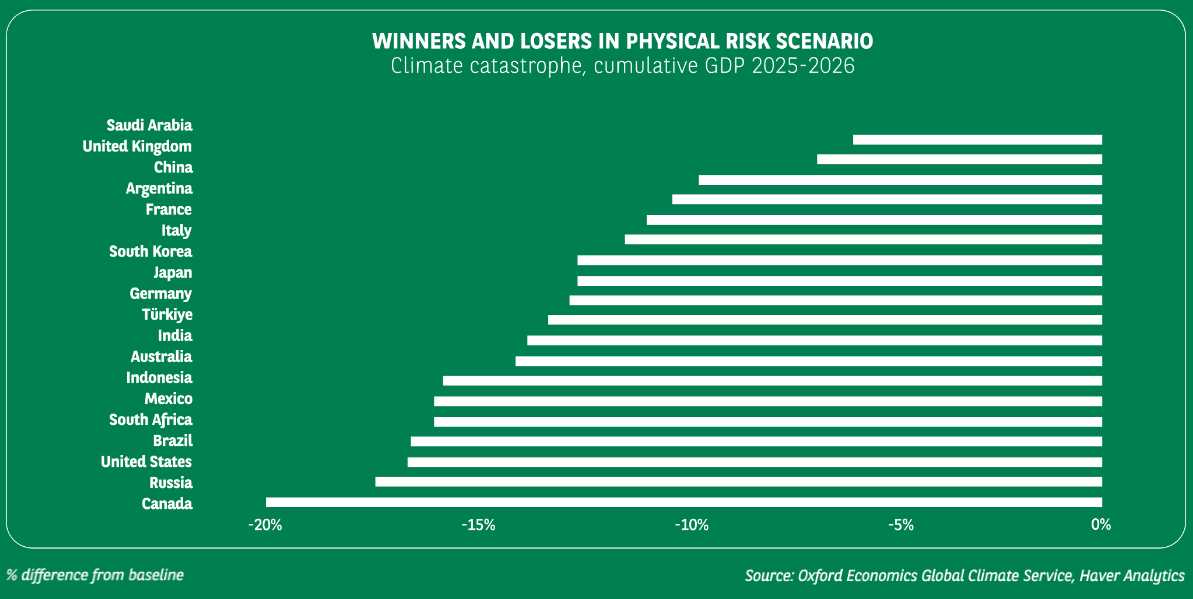
In Climate Catastrophe, governments miss their climate pledges and emissions keep rising. Productivity growth falls faster, and the damage is not fully recovered. World GDP ends about a third below baseline by 2060.
Oil exporters look like early winners in this scenario, because higher fossil fuel demand and commodity prices cushion the blow. Saudi Arabia loses "only" 5.9 percent of cumulative GDP over 2025–2060, and the United Kingdom 6.8 percent. Eventually, however, rising temperatures erode even those gains. There is no scenario in which fossil fuel dependence pays off forever.
Canada is hit hardest at −19.8 percent, followed by Russia (−17.2 percent), the United States (−16.5 percent) and Brazil (−16.4 percent). Germany loses 12.6 percent and France 10.8 percent. In this scenario, every economy loses.
Koen De Leus
Chief Economist at BNP Paribas Fortis
What this means for private equity and venture capital
For equity and bond investors, as well as for private equity and venture capital, this means both opportunity and risk.
One of the main topics in markets today is the impact of the AI buildout on the US and the world economy (which is massive) and its sustainability. For how long will tech companies be able to increase investments in this new industrial revolution? Another question often raised concerns the impact of data centres on demand for energy, water, and other resources.
From an investment perspective, we have argued, and continue to argue, that investors should be exposed to the massive investment opportunity AI brings. Nevertheless, to reduce risk, we should consider investing across the entire AI ecosystem; not only in hyperscalers and chip companies, but also in suppliers like materials, energy and downstream companies that benefit from the efficiency gains the new technology brings – such as industrial, financial, healthcare and biotech companies. Investing in all these sectors logically brings massive opportunities for private equity and venture capital players.
More than anywhere else, this is the case for the energy sector. Energy independence has become a huge theme (we will need more of it). Of course, climate change demands an energy transition to cleaner sources. Therefore, the opportunities in the alternative energy space remain large, but don’t come without volatility. If the speed of the energy transition were to disappoint, so would the returns on investment in this space.
A faster-than-envisioned transition could mean more stranded assets in the more traditional energy complex.
In short, the opportunities are of the magnitude that they can not be simply overlooked and doing one’s homework will be more important than ever to navigate the risks and volatility that come with it.
Philippe Gijsels
Chief Investment Officer at BNP Paribas Fortis