

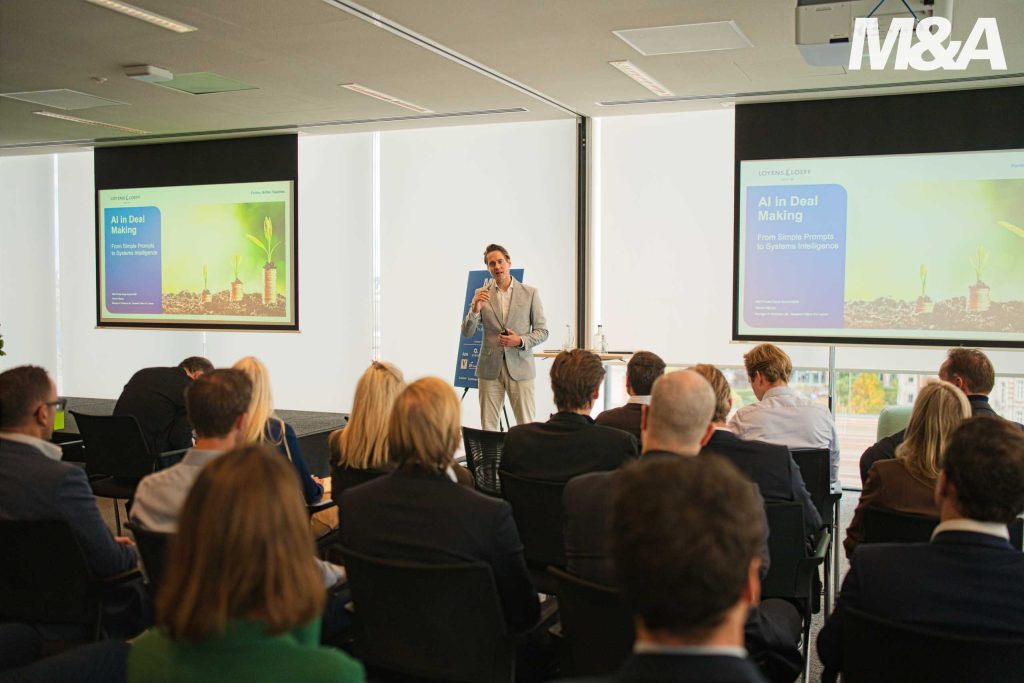
AI is changing not only what private equity firms invest in, but also how they invest. In the masterclass ‘Investing in the Age of AI’ at the Private Equity Summit Belgium, Wessel Wijtvliet, AI solutions lead at Loyens & Loeff and research fellow at the Faculty of Law of KU Leuven, offered a simple test: are you using AI to work a little faster, or to rebuild the way you work?
Wessel opened with a personal story. Years ago, a Belgian fellow student told him the Dutch were “the Americans of Europe”. He had no idea what that meant, until he moved to Brussels and overheard a loud group of Dutch tourists a few bars down the road. “Then it hit me. That colleague had given me a framework, a mental model, but I didn’t have the practical exposure to make it click. That is what I want to do with you today: give you a mental model for AI, and add practical examples to make it come to life.”
A pack of chewing gum
His first slide showed a pack of Wrigley chewing gum, scanned in Ohio in 1974, in what is widely recognised as the first retail transaction using a UPC barcode. He used the contrast between Kmart and Walmart to illustrate two approaches to new technology: making an existing process faster, or redesigning the business around the information it creates.
“What Kmart did was: we need fewer people behind the cash register, and those people can work faster and make fewer mistakes. To put it in corporate parlance: they could be efficient and effective. Something you probably hear a lot about AI as well.”
Walmart saw something else: every product became a data point. That changed its relationship with suppliers, who had to adapt to its data-driven system, and with consumers, as Walmart – rather than the big brands now – understood what sold. Central data also let a sprawling chain of local stores act as one. “They could turn size into scale. Kmart kept the architecture of the previous era and just bolted on scanners. Walmart became a barcode-native company and reinvented the underlying architecture of the firm.”
The question for AI, Wessel said, is the same. “Is AI a tool that makes you as an individual a bit faster? Or is it something that challenges you to completely reinvent the way you do your business?”
Read also: From simple prompts to systems intelligence
Improve, redesign, explore
Wessel’s mental model has three steps. The first, improving existing work, is where most firms are today, and it goes well beyond summarising documents. Contract review can run across hundreds of documents at once. In target screening, AI can help narrow a large company database to a shortlist for further assessment. That accelerates research, but a shortlist is not the same as a completed acquisition.
“You’re still doing the same thing as you did before. But this time, the research that goes into it is much more complete and much faster.” Think of checking whether the data room matches the information request, spotting the economic impact of a redraft, tracking closing conditions or mapping post-closing work. The examples illustrate how many parts of an M&A transaction could benefit from AI support.
“If you are looking for inspiration, there’s no shortage of it.”
The second step is redesigning the service itself. Instead of reading document by document, due diligence could start with the deal risks, such as customer concentration, and search for the information that matters for each risk. The same applies to the deliverable.
Wessel questioned whether a long due diligence report is always the most useful way to communicate findings. “Clients need to understand the risks and how those risks affect their decisions. AI could make it easier to provide relevant updates as the work progresses, alongside the detailed analysis, rather than relying on the final report alone.”
The third step, exploring entirely new services, is the hardest to picture. AI agents that take actions on your behalf, data from an entire portfolio rather than a single deal, and falling costs could all make possible what used to be too expensive in human labour. “I understand this is a little bit clairvoyant.”
Build systems, not one-offs
For busy leaders working from eight to eight, Wessel offered a more practical yardstick. Some teams improve one task and lean back. That rarely lasts: an NDA-review tool that took an engineer half a year to build two years ago now comes standard with legal AI platforms. Others become project accumulators, with pockets across the firm each solving their own problems in their own way. “You're creating a lot of local optima. They all make sense on the individual or team level, but that's where they get stuck.”
The goal is to be a system builder, where every solution becomes a building block for the next. Can the technology be reused by another team? Is the data structured so nobody has to feed the same documents into a chatbot again? Can the way output is validated be captured and reused? Wessel gave an example from his own work: when 20 colleagues use a workflow built on templates, someone has to own those templates.
“You’re not just solving the problem that’s immediately in front of you, but you’re building little things for the future as well. So your efforts are not just going to waste today.”
That matters, he argued, because faster information production can simply move the bottleneck elsewhere. “When AI makes it easier to produce long documents, the recipient still has to read, assess and act on them. Improving individual tasks is therefore not enough: firms also need to redesign how information is shared, validated and turned into decisions.”
The race between natives and incumbents
In the Q&A, the audience pushed on what this means for established firms. Wessel pointed to the rise of AI-native firms, including in law, which may have fewer inherited silos and fragmented systems to work around. Established firms can draw on existing expertise, but need to address those constraints while developing their technology capabilities. That requires new roles and taking “all the boring stuff" of technology and data seriously. Who wins? “New firms need to acquire expertise. Established firms need to mature in technology. I don’t know which one travels faster.”
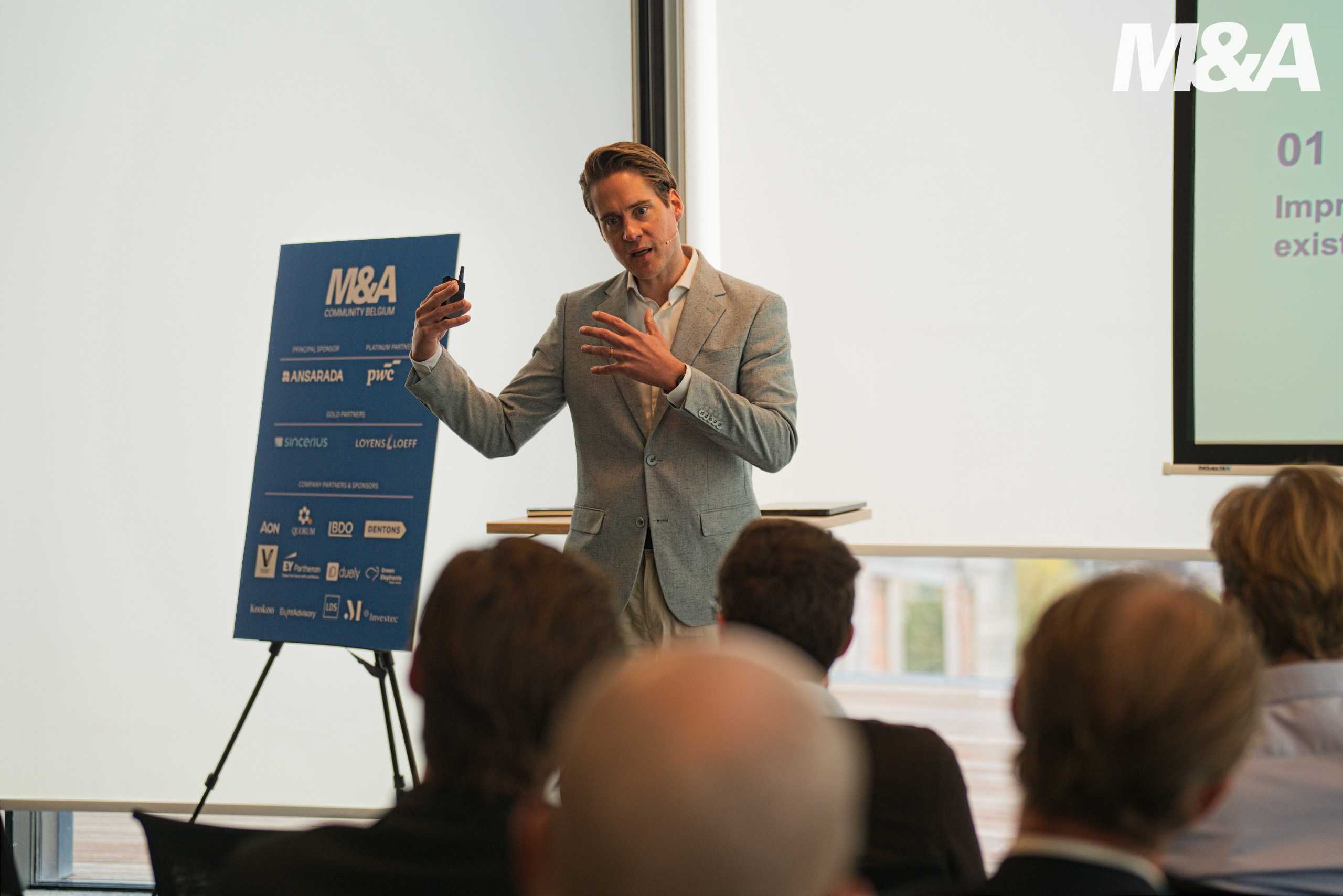
He warned against treating individual use cases as a strategy in themselves. “AI can support increasingly advanced tasks, but its output still needs validation. As capabilities develop, some bespoke solutions may become standard platform features.” His point was not to stop solving practical problems, but to make those solutions contribute to capabilities the firm can reuse and build on.
On revenue models, he expects the conversation to shift from price to value. Making AI really work requires investment in data architecture and engineers, not just a software license. And it lets advisers move up the value chain.
Wessel argued the question isn’t whether a due diligence report has value, but whether the advice helps the client make better decisions. The objective is to help clients understand the risks and their implications for action; the report is one way to deliver that value.
When asked how he would build a firm from scratch, he advocated using the best available tools while investing in the firm's architecture and people. Vendor expertise can support that work, but the firm still needs the internal capability to own its architecture and build on what it develops. His bet was to combine strong people with strong technology.
Returning to his opening anecdote, Wessel closed on a positive note: the American appetite for innovation offers inspiration for Europe. In that spirit, being “the American of Europe” might become a compliment, associated with fresh thinking and the courage to do things differently.

