

Extantia Capital, with Norrsken Evolve, backs Europe’s labour shortage solution: Motion’s HaaS model.
According to Extantia Capital’s founding partner, Yair Reem, you learn a lot about a founder over 14 days on the road together, and vice versa – far more than any data room will tell you. This was the case when Extantia joined Motion CEO and founder Alexander Stevens on a recent trip to China. “He is a natural entrepreneur, a real hustler, always working an angle to get a deal done and finding opportunities for Motion after long meetings when we were ready to go back to the bus. Not least, he's a great guy and good fun to work with,” Yair shares.
During this time, they visited 14 companies (from AGIBOT and Unitree Robotics down to the component suppliers almost nobody in Europe has heard of) across Shanghai, Hangzhou and Beijing, finishing at the World Robot Conference. “What we saw in China was a country deploying humanoids and semi-humanoids on real factory floors. The hardware is available to anyone. The gap sits everywhere else: knowing which robot fits the task, collecting the data, training the model, integrating it into the IT stack, financing it, insuring it, certifying it and keeping a fleet running once the pilot is over,” Yair points out.
“That expertise does not exist inside most European plants, and no factory manager is going to build it from scratch,” he adds.
However, the German climate venture capital firm’s partner, Torben Schreiter, cautions that some VCs tell European founders to build full-stack humanoid platforms. “That's a fast way to lose a fund,” he notes, continuing that most of what looks autonomous isn’t: “Nine in 10 robots sold to the market today have a human controlling them. Moreover, data barely transfers between robot bodies – a five-fingered hand and a two-finger gripper on the identical task are still two separate datasets, and even a change in lighting can force a full retrain. 400 humanoid models mean close to 400 separate data problems; that's the reality in 2026. There’s some real ground still to cover, and getting towards world models is genuine R&D risk.”
Before a humanoid can take its place on the factory floor, it has to learn the specifics of that customer's operations, which starts with collecting real data from the production line. From there, it needs hardware that fits into existing workflows and IT systems without disrupting them. It also has to comply with the EU Machinery Regulation and the AI Act to be certified as safe and compliant. And once it's on the floor, it needs to hold up reliably across multiple shifts, backed by financing, insurance and maintenance structures — for a working lifespan the market still can't fully predict.
This is usually why adoption fails. “Xiaomi told us their own humanoid went from 𝟗𝟎.𝟐 percent 𝐭𝐨 𝟗𝟖 percent success on one task – tightening a nut – after four months of training in their car plant. Compare this to roughly 14 months for putting up the entire factory – stamping and conventional robotics included…” Torben shares some of his learnings from the trip to China.
“The value sits with whoever owns the customer relationship, the deployment data and the financing layer."
Bringing the hands Europe’s factories need
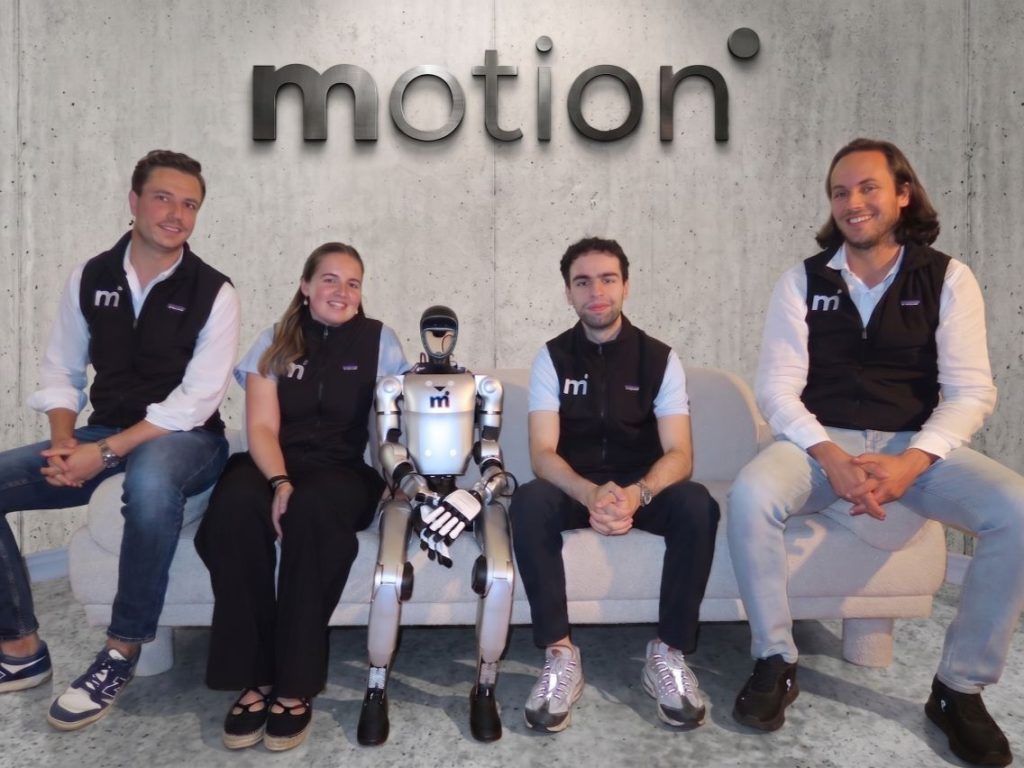
Motion takes everything that stands between a factory and its first humanoid and turns it into one predictable monthly fee. With five pilots currently running on real production lines in Belgian industrial, warehouse and logistics companies – being trained to load goods into crates, pack containers into boxes and place components on conveyor belts, side by side with the human teams they support – its Humanoids-as-a-Service (HaaS) model is proving that it can fill this vacancy.
Yair explains that backing Motion is how Extantia invests in the infrastructure that scales climate technologies faster, while making European manufacturing more efficient, resilient and globally competitive. “The climate transition is ultimately a physical transformation. Someone has to build the batteries, the heat pumps, the wind turbines and the grid equipment, and that is exactly where industrial growth is running into labour shortages, lost expertise and inefficient production,” he says.
“What convinced us to jump on board was Motion's holistic vision on how to keep Europe building with robotics at the core,” echoes Alex Bakir, general partner at the Swedish VC, Norrsken Evolve. Motion’s model covers everything automation requires: data collection, robot selection, task training, IT integration, fleet management, financing, insurance, compliance and maintenance.
Motion plans to use the funding to take the five pilots into full production and substantially multiply its fleet of humanoids to address this gap. “In the past six months, we initiated five pilots on Belgian production lines, hired a team of top robotics and AI engineers, built our software platform, as well as purchased and trained hardware with various OEM partners, not to mention the support of Nvidia and Google Cloud along the way,” Alexander elaborates.
“Physical AI will be one of the defining technologies of the next decade. Europe's factories need hands. We're bringing them,” he concludes.