


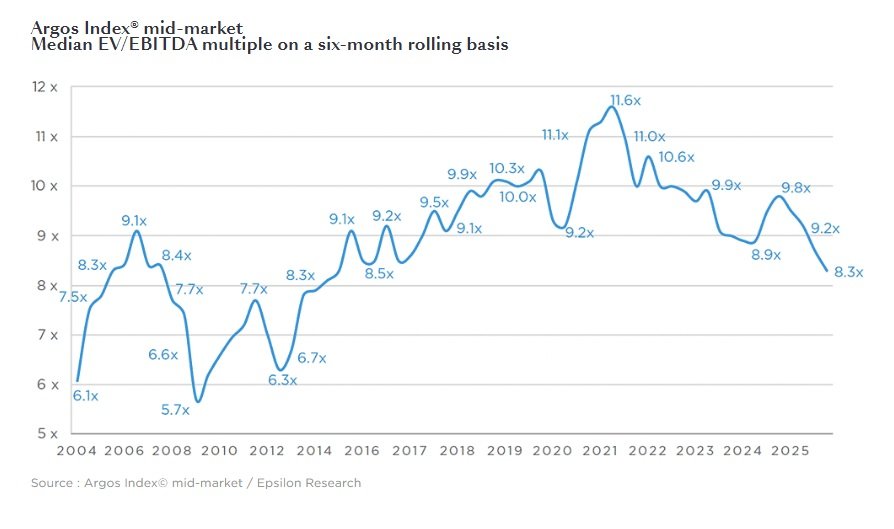
The Argos Index® fell to 8.3x EBITDA in Q4 2025, its lowest level since 2014, as European and Belgium’s mid-market M&A landscape faced persistent downward pressure on valuations.
However, signs of stabilization and a late-year surge in deal activity suggest the market may be approaching a turning point, with lower prices unlocking stalled transactions and narrowing the gap between buyer and seller expectations.
Valuations plummet to 2014 levels, but market shows signs of adjustment
The Argos Index® from European investor Argos declined by 4.6 percent in Q4 2025, reaching 8.3x EBITDA – down from 8.7x in Q3 – driven by a 22 percent drop in multiples for larger deals, while smaller transactions saw relative stability.
The share of deals priced below 7.0x EBITDA remained at a record high of 27 percent, while those above 15x EBITDA fell to just 7 percent, reinforcing a cautious, low-multiple environment. Analysts note that such pricing dynamics often precede a market bottom, as buyers and sellers recalibrate expectations.
Macroeconomic headwinds, including rising long-term interest rates, geopolitical tensions, and policy uncertainty – particularly around Donald Trump’s potential impact on the Federal Reserve and the U.S. dollar – continued to dampen investor confidence. Despite ECB rate cuts, elevated term premia and sovereign debt levels kept financing costs high, further suppressing valuations.
Mid-market M&A activity rebounds amid lower valuations
Against this backdrop, mid-market M&A activity recovered strongly in H2 2025, with deal volumes rising 30 percent compared to H1 and 8 percent year-on-year.
The rebound was underpinned by resilient eurozone fundamentals – stable inflation, improving corporate earnings, and economic growth – alongside Europe’s ability to navigate aggressive U.S. trade policies. Crucially, vendors adjusted price expectations downward, unlocking stalled transactions and revitalizing deal flow.
“Lower valuations have brought buyers and sellers closer together”, said one Brussels-based M&A advisor. “After a prolonged period of misalignment, we’re seeing more realistic pricing and a willingness to transact, particularly in sectors like technology, digital services, and business services, where strategic buyers remain active.”
Investment funds drag Down multiples, while strategic buyers focus on value
Investment funds saw their multiples drop to 8.7x EBITDA in Q4, reflecting ongoing caution around leverage and macroeconomic risks.
However, mid-market LBO volumes surged by 30 percent in H2 2025, mirroring the broader M&A recovery. Financing remained available, and narrowing valuation gaps facilitated deal closures.
Meanwhile, strategic buyers stabilized at 7.7x EBITDA, focusing on targeted, value-accretive acquisitions in resilient sectors. A record 27 percent of their deals were priced below 7.0x EBITDA, signaling disciplined capital allocation. Yet, the rally in public equity markets since early 2025 also enabled high-premium transactions, as corporates used divestitures and asset sales to reshape portfolios.
European private equity fundraising declined year-on-year, but mid-market exit activity rebounded in H2, with volumes up 36 percent as alternative liquidity solutions – such as dividend recaps and continuation vehicles – gained traction.
Outlook: Cautious optimism as market adjusts
The Q4 2025 data suggests Belgium’s M&A market is adjusting to a ‘new normal’ of lower valuations, with activity picking up as sellers accept market realities. While macroeconomic and geopolitical risks persist, the late-year rebound in deal volumes – particularly in the mid-market – points to renewed confidence among buyers and sellers alike.
“A market bottom is often characterized by increased activity at lower prices”, noted an analyst. “With financing still available and strategic buyers actively deploying capital, 2026 could see a gradual recovery provided macroeconomic conditions remain stable.”
For now, Belgium’s M&A players are focusing on quality over quantity, prioritizing transactions that offer clear strategic value at sustainable multiples.